
Proust's madeleine: how one small cake brought back a whole childhood
One bite, dipped in tea, and a whole childhood came back. Here is the most famous madeleine in literature, and why a taste can carry you home.

Last updated 15 October 2026 by Tim Grassin, founder and head pastry chef at Ondine.
Short answer: In Marcel Proust's novel In Search of Lost Time, the narrator dips a piece of madeleine in tea, and the taste brings back a childhood he had forgotten: Sunday mornings at Combray, when his aunt Léonie gave him madeleine dipped in her own tea. Proust called this kind of remembering involuntary memory. Researchers still study it, and smell-cued memories really do tend to reach further back. You can try it yourself with a madeleine, a warm cup of tea and a few quiet minutes.
The moment in the book
You know the feeling. A smell in a stairwell, a song in a taxi, and for a second you are eight years old again. Nobody has described that second better than Proust.
In Swann's Way, the first volume of In Search of Lost Time (1913), the narrator comes home on a cold winter day and his mother offers him tea. She sends out for "short, plump little cakes called 'petites madeleines,'" and, tired after a dull day, he raises to his lips a spoonful of tea with a piece of cake soaked in it. This is what happens next, in C. K. Scott Moncrieff's 1922 English translation:
"No sooner had the warm liquid, and the crumbs with it, touched my palate than a shudder ran through my whole body, and I stopped, intent upon the extraordinary changes that were taking place."
"An exquisite pleasure had invaded my senses, but individual, detached, with no suggestion of its origin."
He does not know where the feeling comes from. He tries again and again to reach it, until he is ready to give up, drink his tea and think about the day's worries. Then:
"And suddenly the memory returns."
The taste was the little crumb of madeleine his aunt Léonie used to give him on Sunday mornings at Combray, when he went to say good day to her in her bedroom, "dipping it first in her own cup of real or of lime-flower tea." From that one taste, Wikipedia's article on involuntary memory notes, he goes on to recall the house and then the whole town.

One line in the passage is easy to miss, and it is the one we love most:
"The sight of the little madeleine had recalled nothing to my mind before I tasted it"
Looking did nothing. Tasting did everything.
It almost was a piece of toast
The madeleine was not Proust's first idea. In 2022, a Paris exhibition at the French National Library marked 100 years since his death, and The Guardian reported what his drafts show. In 1907, the memory was set off by a piece of stale bread dipped in tea. In the next version it was toast. Around 1908 it became a biscotte, a kind of hard biscuit.
In the end he chose the little cakes that "look as though they had been moulded in the fluted scallop of a pilgrim's shell", dipped in the lime-flower tea that The Guardian says his aunt gave him as a boy. We think he chose well: it is hard to imagine a century of readers sighing over stale bread.
The scene became so famous that "Proustian" now means something that evokes the recall of a forgotten memory. If a smell has ever stopped you in the street, you have had a Proustian moment.
Why a taste can carry you back
According to Wikipedia, Proust was the first to coin the term involuntary memory. It means a memory that arrives by itself, set off by something you meet in everyday life, with no effort to remember. Its opposite, voluntary memory, is the kind you dig for on purpose. Proust's narrator felt the dug-for kind was always partial, and that only the involuntary kind carried the real essence of the past.
Psychologists have tested his idea. In a 2006 study in Psychonomic Bulletin & Review, Johan Willander and Maria Larsson of Stockholm University gave 93 older adults a word, a picture or a smell, and asked them to recall any event from their own life. Most of the memories brought back by smells came from the first decade of life, before age 10. Memories brought back by words and pictures peaked in early adulthood, between 11 and 20. The smell-cued memories also came with a stronger feeling of being brought back in time, and people had thought about them less often.
There is a happier finding too. Wikipedia's summary of the research says that happy involuntary memories turn up twice as often as unhappy or neutral ones, citing a 2002 study by Dorthe Berntsen and David Rubin. So when a taste pulls you back, it is more often to somewhere good.
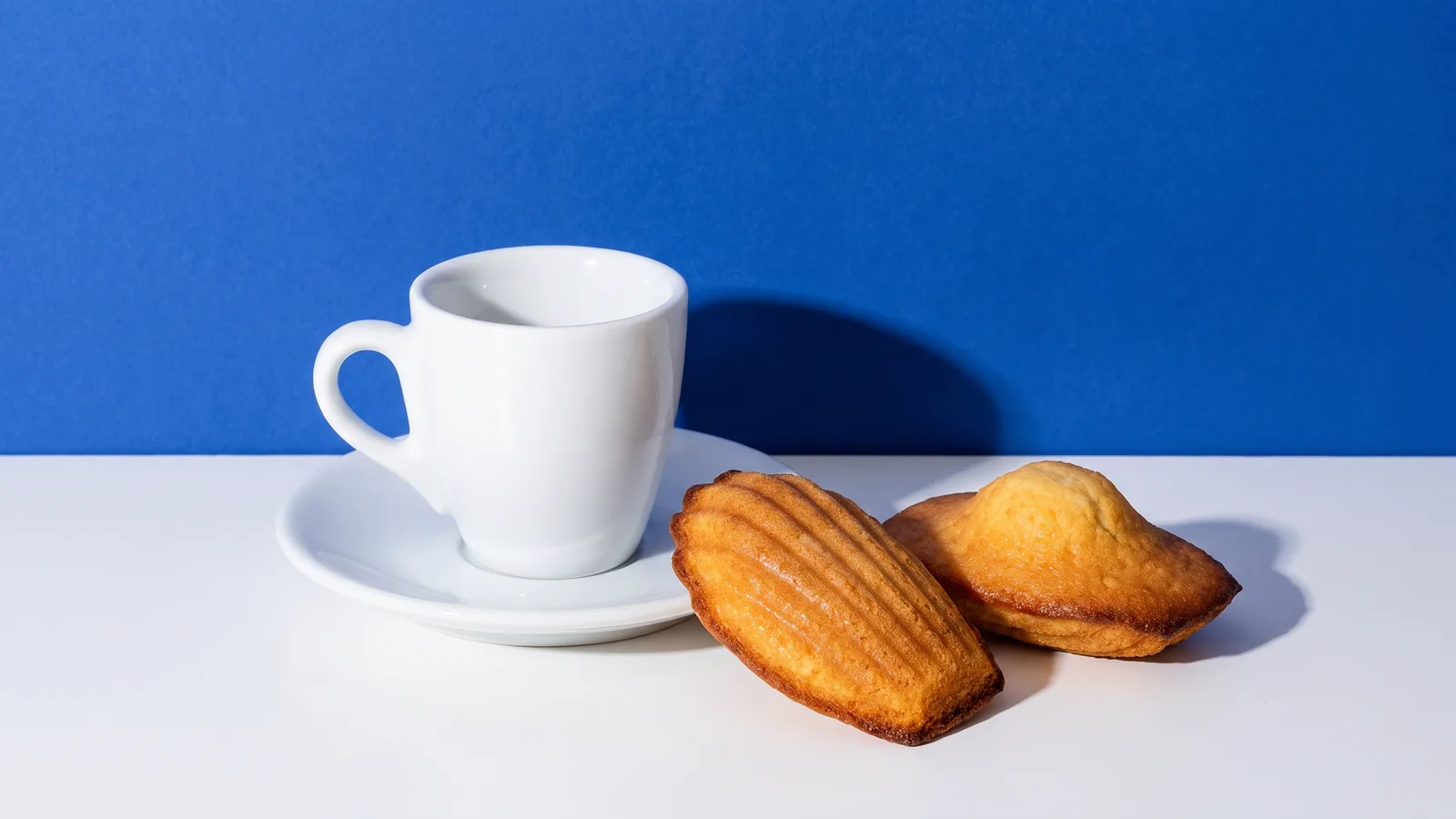
How to have your own madeleine moment
You do not need to read seven volumes. You need a madeleine, a cup and a little time.
- Dip it the way the narrator did. Break off a small piece and let it soak in warm tea for a moment, then taste the crumbs and the tea together. Proust's aunt used "real or of lime-flower tea"; lime-flower tea is the herbal tea made from linden blossoms. Any tea you grew up with works, and that is rather the point. For more pairings, see our guide to madeleines with coffee and tea.
- Taste before you look. In the book, the sight of the madeleine did nothing. Close your eyes for the first bite and notice the crisp edge, the soft middle and the warmth of the tea.
- Do not chase it too hard. In the book, the memory came back just as the narrator was about to give up and think about other things. Give yourself a quiet few minutes with your phone face down.
- Make a small ritual. The same cup, the same corner, the same time on a Sunday. Proust's memory came from a Sunday morning habit, and the little rituals you keep now may be the ones you remember later.
- Give the memory, not just the cake. If a box of madeleines is a gift, put the shared memory into the wish card. Here is a line we wrote as an example: "Sunday mornings at your house, always with tea." A taste plus a line like that is a small time machine.
- Read the passage itself. The 1922 English translation of Swann's Way by C. K. Scott Moncrieff is free on Project Gutenberg. The madeleine scene is in the first part, "Combray".
New to madeleines? Here is what a madeleine is, and how to spot a good one.
A madeleine for your own tea time
We bake every morning and deliver across central Bangkok by Grab Express (roughly Bang Sue to Bang Na, and Thon Buri to Bang Kapi), Monday to Saturday, 10:00 to 18:00, closed on Sundays, often the same day. Every box goes in an Ondine logo bag with a ribbon and a wish card that carries your message.
The Petite 3 (฿290) holds three madeleines: one for you, two to share. The Signature 5 (฿450) holds five, for a table of people who might just remember this afternoon.
Choose your box. If a batch is gone when you look, you can put your name down for the next one.
Sources: Marcel Proust, Swann's Way, in C. K. Scott Moncrieff's English translation (1922, Project Gutenberg); Wikipedia, "Madeleine (cake)"; Wikipedia, "Involuntary memory"; Kim Willsher, "In search of lost toast: Paris show reveals origins of Proust's madeleines", The Guardian, 10 October 2022; Johan Willander and Maria Larsson, "Smell your way back to childhood: Autobiographical odor memory", Psychonomic Bulletin & Review 13, 240 to 244 (2006). All read 15 October 2026. Links: Swann's Way on Project Gutenberg, Wikipedia, Madeleine (cake), Wikipedia, Involuntary memory, The Guardian, Willander and Larsson (2006).
Madeleine News
Fresh flavours, little celebrations and first dibs on the next batch.
Questions
What is Proust's madeleine?
It is a scene in Marcel Proust's novel In Search of Lost Time. The narrator tastes a spoonful of tea with a piece of madeleine soaked in it, and a forgotten childhood memory comes back: his aunt Léonie giving him madeleine dipped in her tea on Sunday mornings at Combray.
Which book is the madeleine scene in?
Swann's Way, the first volume of In Search of Lost Time. It came out in 1913, and C. K. Scott Moncrieff's English translation followed in 1922. That translation is free to read on Project Gutenberg.
What does "Proustian" mean?
Because of this scene, 'Proustian' came to mean something that evokes the recall of a forgotten memory, as Wikipedia's madeleine article notes, citing Merriam-Webster.
Was it always a madeleine?
No. The Guardian reported in 2022 that Proust's drafts used stale bread in 1907, then toast, then around 1908 a biscotte, a kind of hard biscuit, before he settled on the madeleine.
What tea did Proust's aunt use?
In C. K. Scott Moncrieff's translation she dips it in her own cup of 'real or of lime-flower tea'. Lime-flower tea is a herbal tea made from linden blossoms.
Why do smells and tastes bring back childhood memories?
Researchers call these involuntary memories. In a 2006 study of 93 older adults, Willander and Larsson found that most memories cued by smells came from the first decade of life, while memories cued by words and pictures peaked between 11 and 20, and smell-cued memories gave a stronger feeling of being brought back in time.